
13 October 2026 | Invisalign, Preventative Dentistry, Teeth Cleaning

If you are searching for teeth cleaning Melbourne options before starting Invisalign, the priority is not simply making your teeth look cleaner. It is checking that your teeth and gums are healthy enough for planned tooth movement and that you can keep them clean while wearing aligners.
A professional clean may be part of that preparation, but not everyone needs the same treatment or a separate cleaning appointment. Your dentist should assess plaque, hardened deposits, gum health and any untreated dental problems before deciding what needs to happen next.
Why oral health comes before tooth movement
Invisalign moves teeth through a series of clear aligners. Those aligners do not treat tooth decay or gum disease, so these conditions need to be assessed and managed as part of planning.
Plaque is a sticky bacterial film that builds up on teeth. When it hardens into calculus, also called tartar, brushing alone cannot remove it. Deposits near the gumline can make effective cleaning harder and contribute to inflammation.
The Australian Dental Association’s guidance on gum disease distinguishes gingivitis, which affects the gums, from periodontitis, which can damage the tissues supporting teeth. That distinction matters before orthodontic treatment: a routine scale and clean is not a substitute for managing more advanced gum disease.
The teeth cleaning Melbourne patients need before Invisalign should therefore be based on an examination, not a standard cosmetic package. Removing deposits can support better oral hygiene, but a clean alone does not establish that you are ready for aligners.
For an overview of treatment suitability, explore East Melbourne Dental Group’s information about Invisalign as a clear alternative to braces.
Teeth cleaning Melbourne: what happens before Invisalign?
A pre-treatment visit usually combines an assessment with any cleaning your dentist considers appropriate. The scope depends on your recent dental history and what the examination finds.
Checking teeth and gums
Your dentist will look for decay, existing restorations that need attention and signs of gum inflammation. They may assess gum pockets and bleeding, particularly if there are concerns about periodontal health. X-rays may be recommended when clinically indicated, but they are not automatically required at every cleaning appointment.
Tell your dentist about bleeding when brushing, persistent bad breath, sensitivity or teeth that feel loose. Also mention previous gum treatment, medical conditions and medicines that may affect your care.
Removing deposits and reviewing home care
Routine teeth cleaning Melbourne dentists provide involves removing plaque and calculus, with polishing where appropriate to address surface staining. It does not whiten the underlying tooth colour, repair cavities or replace more involved periodontal treatment.
Your dentist can also identify areas that will be difficult to clean once aligners are fitted. Crowded teeth, tight contacts and existing restorations may require a particular approach to interdental cleaning.
Use this appointment to practise any unfamiliar technique. Learning how to use floss or an appropriately sized interdental brush before treatment starts is more useful than buying products without knowing whether they suit your teeth.
When should you book the clean?
There is no universal waiting period between a routine clean and starting Invisalign. The sequence depends on the condition of your teeth and gums, whether other treatment is needed and how your dentist organises treatment records.
An initial Invisalign consultation can take place before cleaning. Your dentist may then recommend a clean, restorative work or gum treatment before final scans or aligner fitting. If a filling or crown will change a tooth’s shape, ask whether that work should be completed before the records used to make your aligners.
For teeth cleaning Melbourne patients arrange before Invisalign, timing should follow the assessment rather than an arbitrary deadline. If your gums are inflamed, your dentist may want to review their response to treatment before proceeding.
If you recently had a professional clean elsewhere, bring the date and any relevant records. You may not need another immediately, although a current assessment is still necessary. A recent clean does not rule out decay or confirm that gum inflammation has resolved.
What could delay your first aligners?
Some findings require a change to the treatment sequence. A delay can allow a dental problem to be treated before appliances make daily care more demanding.
| Finding | Possible next step before aligners |
|---|---|
| Plaque or calculus without significant gum disease | Professional cleaning if needed, plus tailored home-care advice |
| Bleeding or swollen gums | Assessment of the cause, treatment and review of gum health |
| Deep gum pockets or loss of tooth support | Periodontal assessment, treatment and possible specialist input |
| Untreated tooth decay | Restorative treatment before proceeding where required |
| Tooth pain, swelling or a suspected infection | Prompt dental assessment rather than waiting for the planned aligner visit |
Bleeding gums do not automatically mean Invisalign is unsuitable. They do mean the cause should be investigated. Likewise, a history of periodontitis does not automatically exclude orthodontic treatment, but it can change the planning and monitoring required.
If you develop significant pain or swelling while preparing for treatment, contact your dentist promptly. Do not assume a routine cleaning appointment will address the problem.
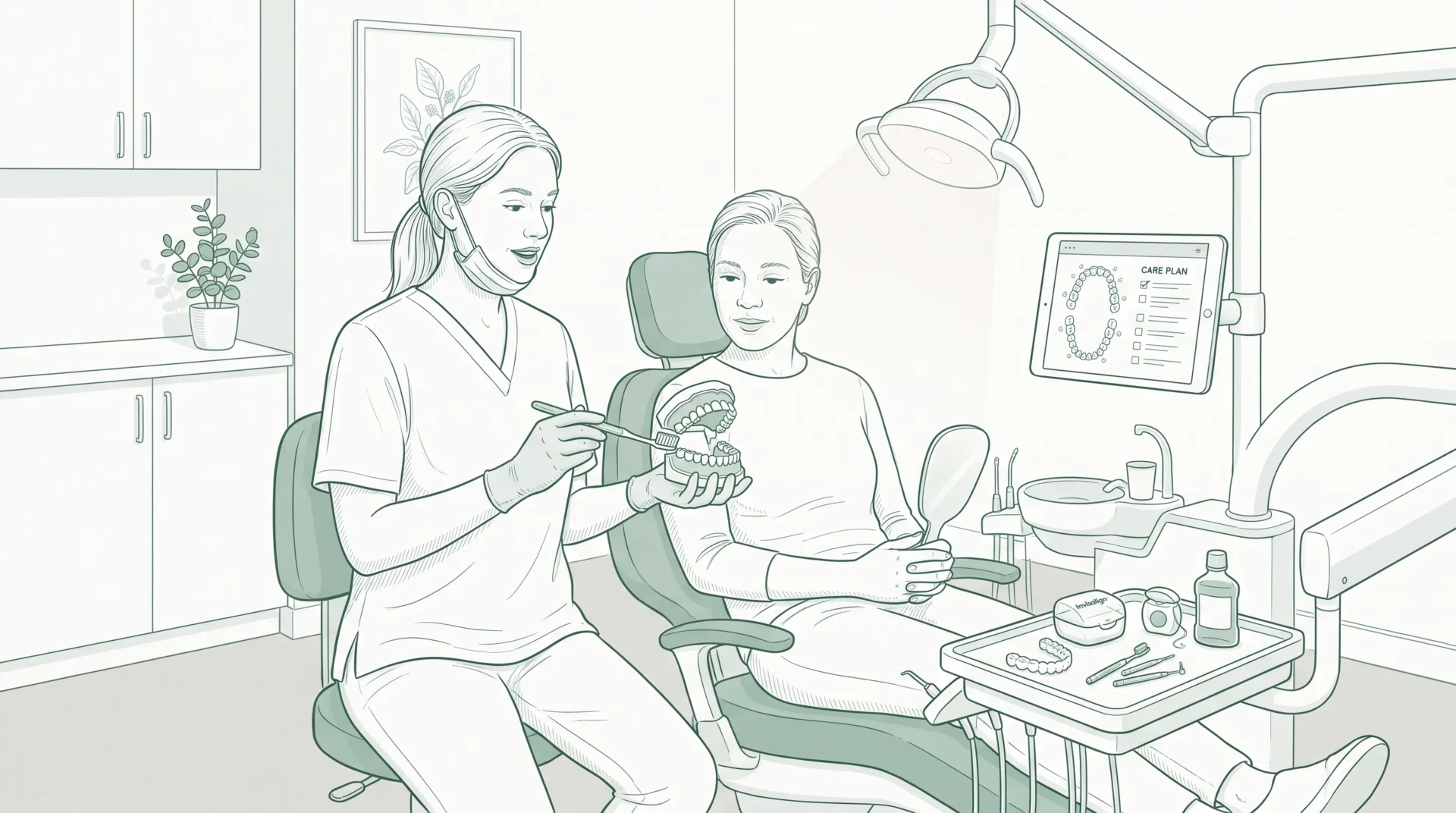
Keeping teeth clean once aligners are fitted
A pre-treatment clean is a starting point, not protection for the entire course of Invisalign. Aligners cover the teeth for much of the day, making consistent hygiene particularly important.
Remove aligners for food and drinks other than plain water, following your treating dentist’s instructions. Sugary or acidic drinks under trays can keep those substances in contact with teeth. Before reinserting aligners after meals, clean your teeth as advised and make sure the trays are clean too.
Build a routine you can maintain
Brush twice daily with fluoride toothpaste and clean between your teeth each day. Ask your dentist how to manage brushing after meals, especially after acidic food or drinks. If brushing is temporarily unavailable, rinsing with water can help clear loose food, but it does not replace proper cleaning.
Clean aligners according to the manufacturer’s instructions and your dentist’s advice. Avoid hot water, which can distort trays, and do not assume products intended for teeth are suitable for aligners.
The teeth cleaning Melbourne patients need during treatment may vary with their gum health and how effectively they remove plaque. Keep preventive appointments on the schedule your dentist recommends, rather than assuming aligner reviews replace them.
East Melbourne Dental Group’s advice on protecting your smile between check-ups provides a useful foundation for that daily routine.
Clarify what your appointments and fees include
If you are comparing teeth cleaning Melbourne options, ask what each appointment includes. An examination, routine scale and clean, X-rays and periodontal treatment are different services, even when some are provided at the same visit.
An Invisalign consultation or treatment quote should not be assumed to include all general dental care. Similarly, a free cosmetic consultation does not necessarily include cleaning or diagnostic services. Confirm the scope before booking.
Useful questions to ask include:
- Does my mouth need a routine clean or more involved gum treatment?
- Should cleaning and any restorative work happen before my final Invisalign scan?
- Are preventive visits charged separately from my aligner treatment?
- What follow-up is needed before you can confirm I am ready to start?
For more detail on the components of an appointment, see the practice’s guide to what teeth cleaning costs in Melbourne may include. Request an individual estimate rather than treating a general price guide as your treatment quote.
Frequently asked questions
Is a professional clean compulsory before Invisalign? Not for every patient. Your dentist will consider existing deposits, gum health and when you last had a clean. The requirement is appropriate oral health assessment and management, not automatically repeating a recent cleaning appointment.
Can I have a clean and an Invisalign scan on the same day? Sometimes, depending on the findings and appointment arrangements. If gum treatment or dental work is needed first, final records may be scheduled later. Confirm the sequence with your treating dentist.
Do I need another clean if I recently had one? Not necessarily. Any teeth cleaning Melbourne patients have had recently can be considered alongside a current examination. Share the date, the treatment provided and any concerns your previous dentist identified.
Will cleaning help Invisalign work faster? A professional clean is not a proven shortcut to faster tooth movement. Its role is to remove deposits where needed and support oral health. Treatment progress depends on the planned movements, biological response and following your dentist’s instructions.
Will cleaning make my teeth whiter before aligners? It may remove some external staining, but it does not bleach teeth. If whitening interests you, discuss its suitability and timing separately from your pre-Invisalign clean.
Plan your preparation before starting Invisalign
Ask for a clear sequence: oral health assessment, any necessary cleaning or treatment, final records and aligner fitting. That makes it easier to understand both your readiness and the costs involved.
East Melbourne Dental Group offers Invisalign consultations. When booking, mention that you would like advice on cleaning and gum health before treatment so the team can guide you towards the appropriate appointment.
Disclaimer
The information provided on this website is for general informational and educational purposes only. It is not intended to replace professional dental advice, diagnosis or treatment. Dental needs and treatment outcomes vary between individuals. Always seek advice from a qualified dental practitioner regarding your specific circumstances before making decisions about your oral health or treatment. A consultation and clinical assessment are required to determine which treatment options may be suitable for you. All dental procedures carry potential risks and benefits, which will be discussed with you before treatment.